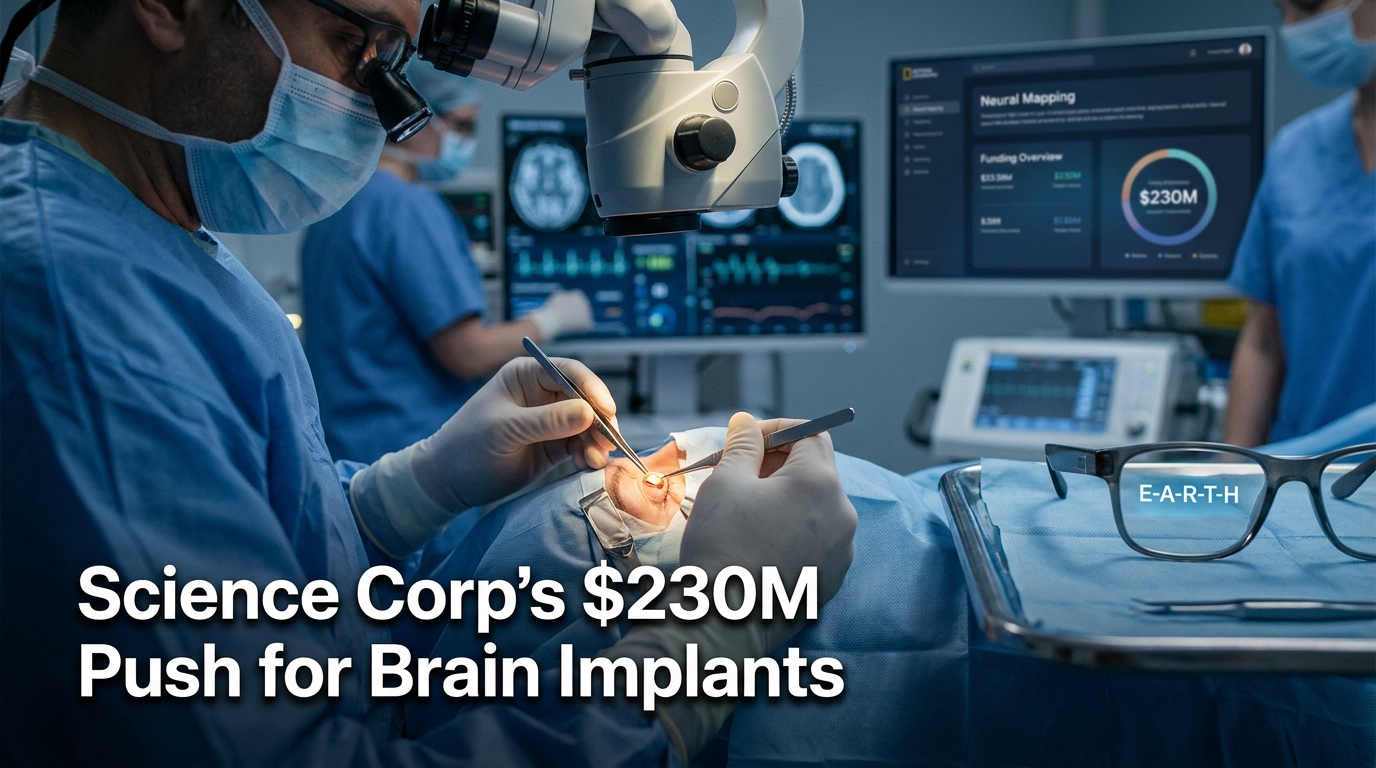
Science Corp, led by Neuralink co-founder Max Hodak, just raised $230 million in Series C funding at a $1.25 billion post money valuation. This brings their total funding to nearly $490 million, fueling efforts to launch the first brain computer interface (BCI) product soon. While AI dominates venture capital, Science Corp focuses on life changing neurotech for vision restoration and beyond.
Max Hodak’s Vision
Max Hodak co-founded Neuralink with Elon Musk but left in 2021 to start Science Corp, emphasizing safer, scalable BCI solutions. The company, now with 150 employees, operates from a large facility in Alameda, CA, and targets unmet needs in medicine like blindness and organ preservation. Investors including Lightspeed Venture Partners, Khosla Ventures, Y Combinator, Quiet Capital, and IQT see huge potential in their pipeline.
Unlike pure AI plays, Science Corp blends biotech with engineering for clinical breakthroughs. Their vertically integrated approach from implant design to trials speeds progress toward market ready devices. Hodak’s vision: biohybrid tech that grows living neurons for seamless brain integration, minimizing damage while maximizing connections.
PRIMA: Vision Restoration Breakthrough
PRIMA , Science Corp’s lead product, is a rice grain sized subretinal implant paired with smart glasses to restore central vision in patients with geographic atrophy (GA) from age related macular degeneration (AMD). Acquired from Pixium Vision in 2024 and refined, it bypasses dead photoreceptors by stimulating inner retinal cells directly. AMD affects over 5 million worldwide, making PRIMA a potential game changer.
In trials with 47 patients across Europe and the US, 80% showed meaningful visual acuity gains, reading letters, numbers, and words fluently first time proof in blind patients. Peer reviewed in the New England Journal of Medicine, results confirmed 81% improvement at 12 months (logMAR 0.2 or 10 ETDRS letters), with no peripheral vision loss. Safety profile strong: 95% of early adverse events resolved in two months.
PRIMAvera study (NCT04676854) targets dry AMD; expansions cover Stargardt disease and retinitis pigmentosa top causes of young adult blindness. Glasses feature camera, IR projector, pocket processor for zoom/brightness, and sun lenses. Based on Stanford’s Daniel Palanker’s work, it powers via light, no batteries needed.
Launch Roadmap
Science Corp submitted CE Mark to EU, eyeing mid 2026 approval and Germany launch first via early access pathways. US FDA talks ongoing; this could make them the first BCI with a market product. Featured on Time magazine cover, PRIMA signals BCI’s medical shift from sci-fi to reality.
Future Tech: Biohybrid and Vessel
Beyond PRIMA, Science develops biohybrid neural interfaces: stem cell neurons grown on “waffle-like” brain surface devices for biological connections, outperforming electrodes in scaling and safety. Mouse tests detected light signals, hinting at advanced BCI for paralysis or cognition.
Vessel, their organ preservation platform, miniaturizes perfusion technology for flight transport or home use, reducing ICU reliance. Normothermic machine perfusion (NMP) already boosts high risk organ viability e.g., livers up to 24 hours vs. static cold storage reducing discards. RCTs show NMP superiority for hearts, lungs, livers.
BCI Market Surge
Global BCI market: $3.07B in 2025, projected $13.32B by 2035 (15.81% CAGR), driven by non invasive tech, AI algorithms, wireless electrodes. Medical adoption surges for neuro rehab; military/gov interest grows. Science Corp trails only Neuralink in funding/valuation, positioning as blindness treatment leader.
Summary: Science Corp’s Transformative Impact
Science Corp stands at the forefront of brain computer interfaces, bridging biotech and neuroengineering to tackle blindness, organ logistics, and neural disorders head on. With $230 million fueling PRIMA’s commercialization targeting mid 2026 EU launch this rice sized retinal implant, paired with AR glasses, has already empowered 80% of trial patients (n=47) to read fluently, a milestone validated in NEJM and celebrated on Time’s cover. Expansions to Stargardt and RP address youth blindness, while Germany’s fast-track pathways signal imminent real world deployment.
Max Hodak’s post Neuralink venture emphasizes biological integration: biohybrids cultivate stem derived neurons on cortical arrays for scar free signaling, proven in rodents to detect stimuli with superior fidelity. Vessel revolutionizes transplants via portable perfusion, extending organ life beyond ICU bounds critical as NMP trials double viability for marginal donors, curbing 20-30% discard rates. Backed by top VCs and IQT for gov scale applications, Science Corp’s $1.25B valuation underscores its edge in a $3B+ BCI market exploding to $13B by 2035.
Yet, hurdles persist: ethical data privacy, long term biocompatibility, and equitable access amid high costs. Competitors like Neuralink are pursuing high volume production, but Science Corp’s clinical lead in vision, coupled with Vessel’s logistics innovation, positions it uniquely. Trends point to 2026 breakthroughs: AI enhanced signal processing, mental health implants, and hybrid bioelectronics defying surgery via vascular delivery. Hodak’s team, now 150 strong, vertically controls the stack from fabrication to trials, promising faster iterations. As BCIs mature from paralysis aids to cognitive enhancers, Science Corp exemplifies how targeted neurotech can restore human potential, potentially redefining medicine’s frontiers for millions worldwide.
Check out more on our blog page now → AI, Tech, Cybersecurity