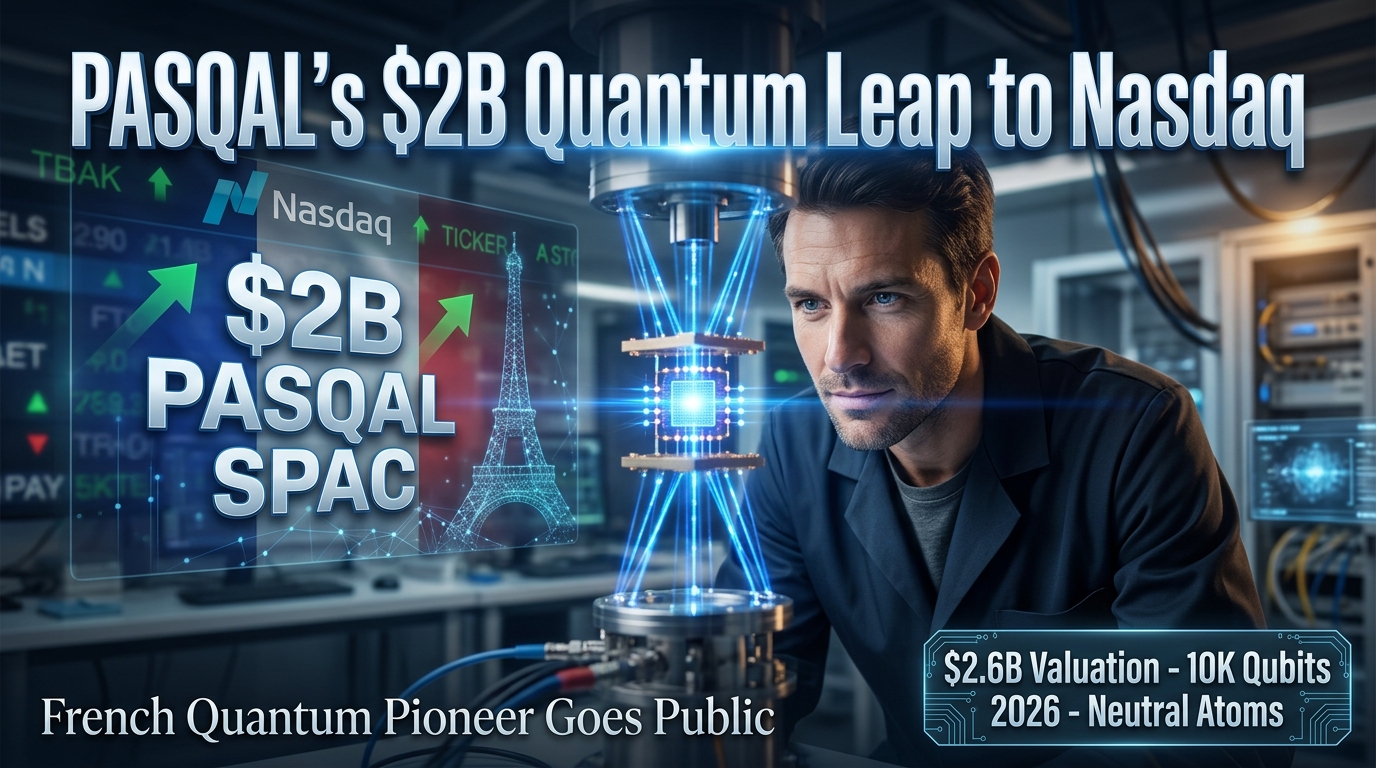
French quantum pioneer Pasqal is accelerating toward public markets with a $2 billion SPAC merger on Nasdaq, fueled by investor enthusiasm for scalable quantum tech. This strategic step not only unlocks massive capital but also positions Pasqal to compete globally while nurturing its European innovation hub.
SPAC Merger Breakdown
Pasqal’s merger with Bleichroeder Acquisition Corp II targets Nasdaq closure in H2 2026, yielding $600 million+ in proceeds: $289 million from SPAC trust, $200 million private round, plus convertibles. Pro-forma enterprise value hits $2.6 billion, enabling production doubling within 24 months.
New investors Parkway, Quanta Computer, LG Electronics, and CMA CGM join stalwarts like Bpifrance, European Innovation Council Fund, Temasek (2023 Series B lead), Saudi Aramco Ventures, and ISAI. This capital war chest supports R&D and global scaling amid a quantum market exploding from $5.59 billion in 2026 to $25.63 billion by 2032 at 28.6% CAGR.
Dual-listing on Euronext follows in 2026-2027, mirroring peers like IQM and leveraging U.S. multiples unavailable in tighter European markets.
French Roots, Global Ambition
Headquartered in Palaiseau’s quantum cluster home to EDF and Thales Pasqal vows to stay a French entity, appointing a French non-executive chair and retaining Bpifrance on board and cap table. Plans include 50 high-skill hires over 18 months, building on 275+ staff (70 PhDs).
Michel Combes, telecom titan from Vodafone and Alcatel-Lucent, steps in as lead independent director, his SoftBank tenure boosting French startups like Swile despite earlier Nokia deal backlash. Recent exec shifts: Wasiq Bokhari to CEO, Loïc Henriet to CTO.
In tense geopolitics, French status aids access, as Mistral AI’s deals show, while creating taxpayer-backed jobs in optimization, simulation, and security.
Neutral Atoms: Scalable Superiority
Level diagram depicting the Hamiltonian of two neutral atoms interacting via Rydberg interaction for Rydberg mediated gates in neutral atom quantum computers.
Pasqal’s neutral atoms laser-trapped Rydbergs outshine rivals: identical “nature’s qubits” avoid fab defects, room-temp operation cuts cryo costs/power (vs. superconductors), millisecond coherence, 3D reconfigurable arrays for native connectivity, fewer controls to 10k qubits.
Co-founder Nobel’s Alain Aspect’s entanglement work enables Rydberg gates for MIS/Max Clique solves intractable classically. Vs. IQM (superconducting, fixed 2D, mK temps), IonQ (trapped ions, high fidelity but slow scaling), Rigetti (superconducting fab).
This level diagram shows Rydberg atom interactions key to Pasqal’s gates, with detuned lasers coupling states for precise control.
Proven Milestones, Bold Roadmap
Pasqal met goals: >1000-atom 2D arrays, Orion Beta delivery 2024-25. Roadmap: 1000 physical/logical qubits 2025; 250-qubit quantum advantage demo 2026; 10k+ qubits 2027 with photonic integration; 100-200 logical qubits fault-tolerant by 2029-30 via modular Vela/Centaurus.
Transparency sets Pasqal apart, tying milestones to breakthroughs like error-corrected logical qubits early.
Real-World Use Cases
With Aramco: quantum optimization for supply chains (QAOA/MIS graphs), VQE for catalysts/carbon capture hybrid NISQ demos validated classically.
Other wins: cryptographic testing via adiabatic methods, industrially reliable optimization; physics-informed ML for simulations.
Expands to energy scheduling, finance portfolios amid 31.6% CAGR market to $18B+ by 2034.
Industry Impact and Challenges
Drug discovery: atomic sims for proteins/cancer drugs, compressing datasets to qubits for efficiency.
Cybersecurity: QRNGs unbreakable keys, threat detection on vast data, PQC prep quantum threats loom.
Challenges: NISQ noise demands error mitigation; Pasqal’s analog/digital hybrid bridges to FTQC. U.S. peers’ stocks surged, signaling frenzy.
Pasqal’s trajectory promises quantum utility soon, reshaping compute paradigms.
Pasqal’s Quantum Revolution: $2B Nasdaq SPAC Summary
French quantum computing leader Pasqal is making headlines with a landmark $2 billion SPAC merger with Bleichroeder Acquisition Corp II, targeting Nasdaq listing in the second half of 2026. This deal values Pasqal at $2 billion pre-money with a pro-forma market cap of $2.6 billion, delivering over $600 million in gross proceeds including $289 million from the SPAC trust, a $200 million private funding round from investors like Parkway, Quanta Computer, LG Electronics, CMA CGM, and ongoing support from Bpifrance, Temasek, and Saudi Aramco Ventures.
Strategic Dual Listing Approach
Pasqal commits to its French identity, maintaining headquarters in Palaiseau’s quantum innovation cluster near Paris tech hubs like EDF and Thales, while planning a secondary Euronext listing in 2026-2027. This hybrid strategy captures U.S. market scale and revenue multiples unavailable in Europe, following Finnish rival IQM’s recent SPAC path, while reassuring French stakeholders Bpifrance retains board and cap table presence, and a French non-executive chair will join.
The company plans 50 high-skill hires over 18 months, building on 275+ employees including 70 PhDs, emphasizing job creation in a geopolitically sensitive climate where European identity aids partnerships, as seen with Mistral AI.
Neutral Atom Technology Leadership
Pasqal differentiates through neutral atom quantum processors laser-trapped Rydberg atoms offering identical “nature’s qubits,” room-temperature operation slashing cryogenic costs, millisecond coherence times, and 3D reconfigurable arrays enabling native connectivity to scale beyond 10,000 qubits efficiently. Co-founded by Nobel laureate Alain Aspect, whose entanglement research powers their Rydberg blockade gates, Pasqal outperforms superconducting rivals like IQM (cryogenic 2D fixed layouts) and trapped-ion systems like IonQ (high fidelity but linear scaling limits).
As a full-stack provider, Pasqal delivers hardware (Orion/Vela systems deployed to 25+ clients including Sumitomo and Aramco), software, and cloud access via Google Cloud, Azure, OVH, IBM Quantum Network, and NVIDIA partnerships, generating tens of millions in annual revenue from labs and industry.
Proven Milestones and Ambitious Roadmap
Pasqal has achieved over 1,000-atom 2D arrays and Orion Beta deliveries ahead of schedule. Their transparent roadmap targets 1,000 physical/logical qubits in 2025, 250-qubit quantum advantage demonstrations in 2026 alongside Nasdaq debut, 10,000+ qubits by 2027 with photonic links, and 100-200 fault-tolerant logical qubits by 2029-2030 through modular Vela/Centaurus platforms fueled by doubled production capacity.
Leadership includes new CEO Wasiq Bokhari and CTO Loïc Henriet, with telecom veteran Michel Combes as lead independent director bringing Vodafone/Alcatel-Lucent expertise.
Real-World Applications Driving Value
Pasqal’s NISQ-era wins span Saudi Aramco collaborations on QAOA supply chain optimization (30% faster), VQE catalyst design for carbon capture, cryptographic testing, and physics-informed machine learning. Broader potential transforms drug discovery via atomic-scale molecular simulations compressing vast datasets for cancer therapies, cybersecurity with quantum random number generators for unbreakable encryption and post-quantum readiness, energy scheduling, finance portfolio optimization, and materials science amid a quantum market surging from $5.59 billion in 2026 to $25.63 billion by 2032 (28.6% CAGR).
Challenges like NISQ noise are met with hybrid analog/digital error mitigation bridging to fault-tolerant quantum computing (FTQC), positioning Pasqal at the forefront as U.S. quantum stocks rally on commercial promise.
This SPAC validates neutral atom scalability and Europe’s quantum ambitions, promising utility scale breakthroughs that reshape computation across industries while balancing innovation with strategic French roots.
Check out more on our blog page now → AI, Tech, Cybersecurity