

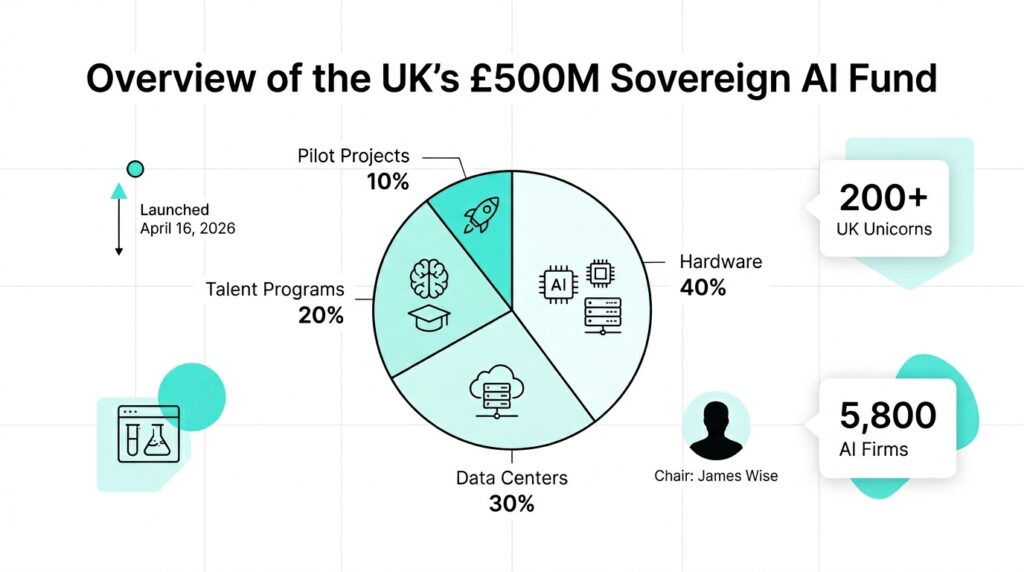
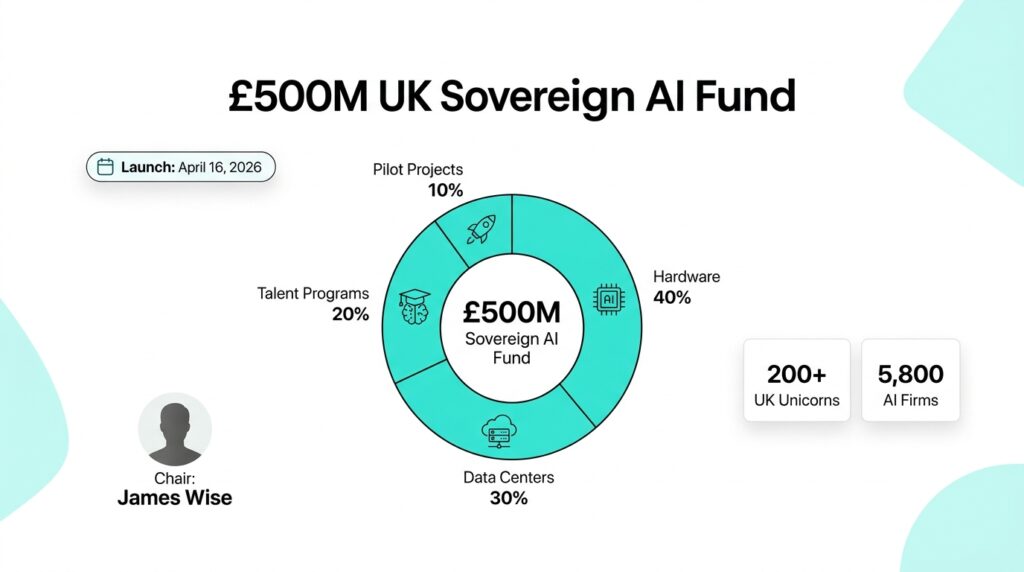
The UK is launching a major sovereign AI fund to build its own computing powerhouse, cutting reliance on foreign cloud giants. With £500 million from the Department for Science, Innovation and Technology (DSIT), this initiative promises secure, homegrown AI infrastructure. It launches formally on April 16, 2026, at 6pm GMT, chaired by James Wise of Balderton Capital. The goal? Turn the UK into a tech producer, not just a user, boosting supply chains and data control.
Roots in British Tech Legacy
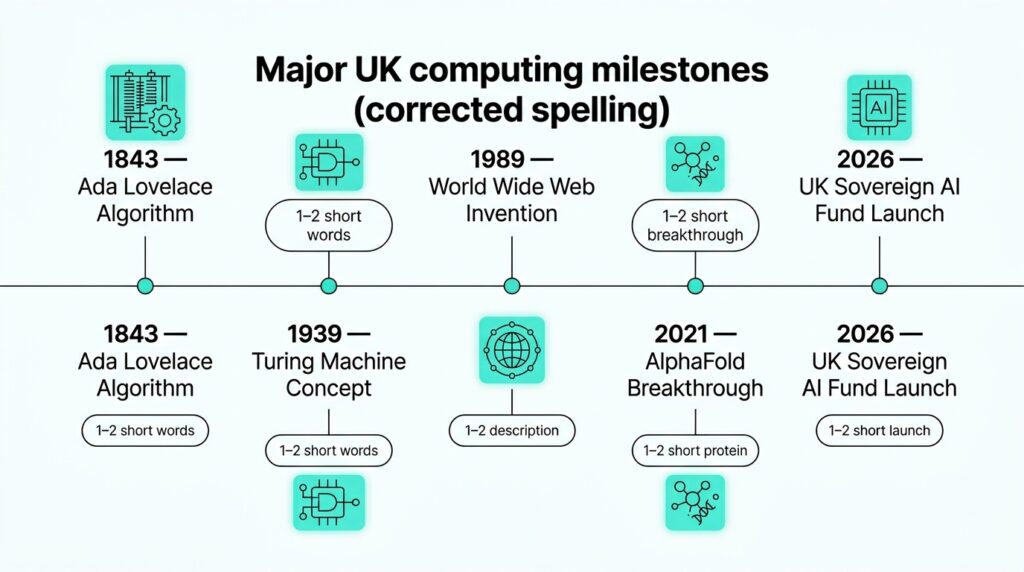
Britain’s computing story starts early. Ada Lovelace envisioned programmable computers in 1843 with her notes on Babbage’s Analytical Engine the world’s first algorithm. Alan Turing cracked Enigma in WWII and theorized machine intelligence in 1950, laying AI foundations. Tim Berners Lee invented the World Wide Web at CERN in 1989, revolutionizing data sharing. Fast forward to Google DeepMind’s 2021 AlphaFold2, solving protein folding and earning a Nobel in 2024 for chemistry.
Today, the UK’s £1 trillion tech sector hosts over 200 unicorns and 5,800 AI firms Europe’s biggest cluster. Per a 2025 DSIT report, AI contributes £170 billion annually to GDP, with projections hitting £400 billion by 2030. The fund taps this by keeping IP local, fostering startups in chips, quantum computing, and biotech.
Why Domestic AI Infrastructure Matters
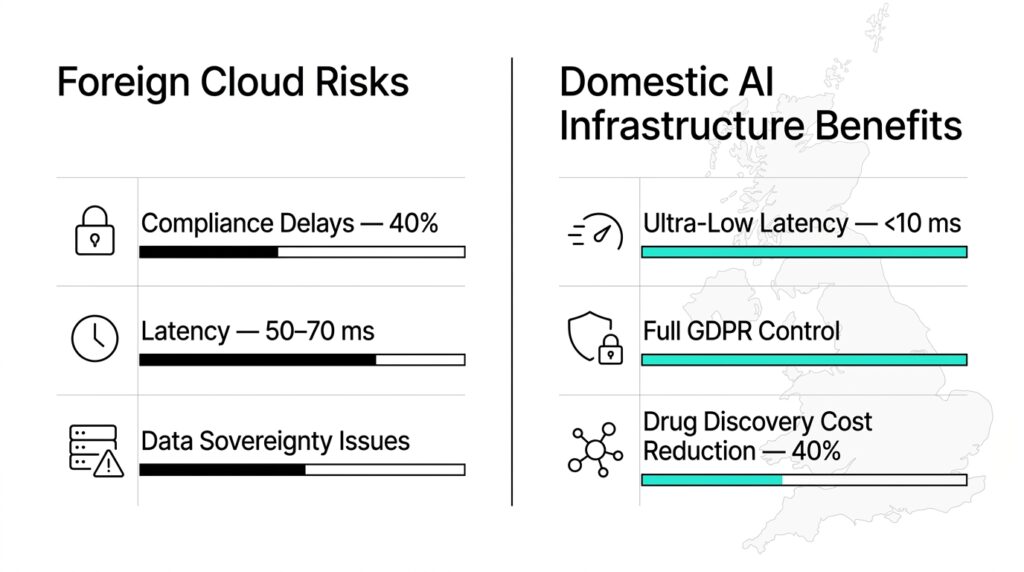
Big clouds like AWS, Google Cloud, and Azure dominate, but they pose risks. Storing sensitive data abroad means wrestling with GDPR, US CLOUD Act, and export controls hurdles for banks, pharma, and defense. A 2025 NCSC report flagged 40% of UK firms facing compliance delays from foreign hyperscalers.
The fund counters this via the AI Research Resource (AIRR), linking supercomputers like Bristol’s Isambard AI (world’s greenest, with 10,000+ Nvidia H100 GPUs) and Cambridge’s Dawn. These offer low latency processing reducing delays by 50-70% for local users. Businesses gain ROI through easier compliance and no data border hops. The fund also seeds domestic devs as an “anchor investor,” per DSIT’s 2026 strategy.
Expansion includes £100 million Advance Market Commitments (AMCs). Government buys verified hardware for public supers, de-risking startups. New Growth Zones in South Wales and Culham provide data center space, backed by 1GW grid upgrades vital as AI training guzzles power (one GPT-4 run equals 300 households yearly, per 2025 Oxford study).
Real World Wins: OpenBind and Beyond
The fund’s first move: £8 million seed to OpenBind Consortium in 2026. This maps molecule protein binds at 20x prior scale 10 billion interactions versus 500 million. Pharma giants like AstraZeneca shave drug discovery from 5-7 years to under 3, cutting costs 40%, per consortium data. It builds on AlphaFold, enabling UK-led therapies without US server dependencies.
Finance benefits too. Local models analyze transactions sans export risks vital post 2024 Barclays breach exposing cloud flaws. Logistics firms map UK supply chains 30% faster, dodging disruptions like 2025 port strikes. A 2026 BEIS analysis predicts £50 billion annual savings across sectors from localized AI.
Further, the fund eyes quantum integration. UK’s National Quantum Computing Centre (NQCC) partners for hybrid systems, targeting 2030 fault tolerant qubits. This positions Britain in post Moore’s Law computing, where domestic hardware cuts import reliance (UK imports 90% of chips, per 2025 trade data).
Tackling Hardware and Talent Gaps
Shifting to homegrown hardware demands skills. Legacy software chokes on new architectures like Arm based or RISC-V chips pilots fail 60% due to team gaps, says a 2025 McKinsey report. The fund’s AMCs guarantee markets, with £100 million buying gear hitting benchmarks (e.g., 10 petaflops efficiency).
Growth Zones in South Wales (Gigafactory hub) and Culham (fusion site) offer 500MW power and fiber optics. This mirrors US CHIPS Act successes, where subsidies spurred 20% domestic fab growth.
Talent is key. The Encode fellowship, expanded with £20 million, draws global experts to UK labs 100 fellows yearly, focusing on AI safety and hardware. It builds on UK’s 2025 visa reforms, netting 15,000 tech migrants. Firms syncing R&D here gain steady engineers, slashing hiring costs 25%.
Broader Economic and Global Ripple
This fund cements UK’s AI leadership. With 84,000 AI jobs (fastest growing sector), it could add 200,000 by 2030, per Tony Blair Institute. Export potential soars domestic supers license tech abroad, like Isambard AI’s green model eyed by EU.
Risks? Power demands strain grids (AI data centers need 8% UK electricity by 2030). Mitigation includes nuclear (Sizewell C) and offshore wind. Geopolitics favors it too post US export curbs on Nvidia chips, sovereignty shields UK from bans.
Enterprises should prep: Audit data for AIRR migration, train on local GPUs, join Encode. Long term, it slashes licensing (Azure bills up 300% since 2023) and boosts resilience.
For US readers, it’s a blueprint. Like Biden’s 2022 Executive Order on AI infra, UK’s model shows public .private wins without full nationalization.
In sum, the UK’s sovereign AI fund isn’t just infrastructure it’s a strategic pivot for tech sovereignty.
Check out more on our blog page now → AI, Tech, Cybersecurity