
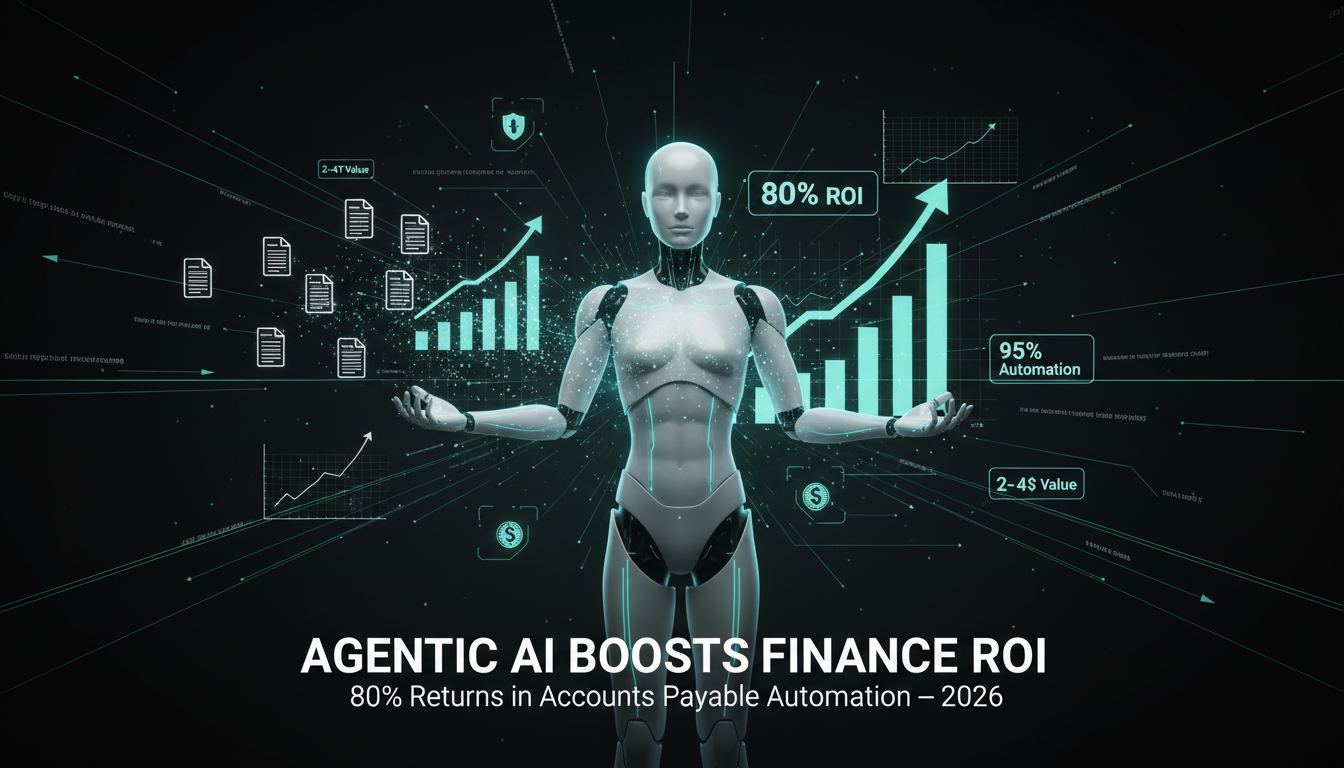
Finance leaders are harnessing agentic AI to supercharge accounts payable (AP) automation, transforming tedious manual tasks into smart, self running workflows. Last year, general AI projects hit a solid 67% ROI on average. But agentic AI autonomous agents that handle complex processes without constant human nudges crushed it at 80%. This gap is pushing CIOs to rethink automation budgets entirely.
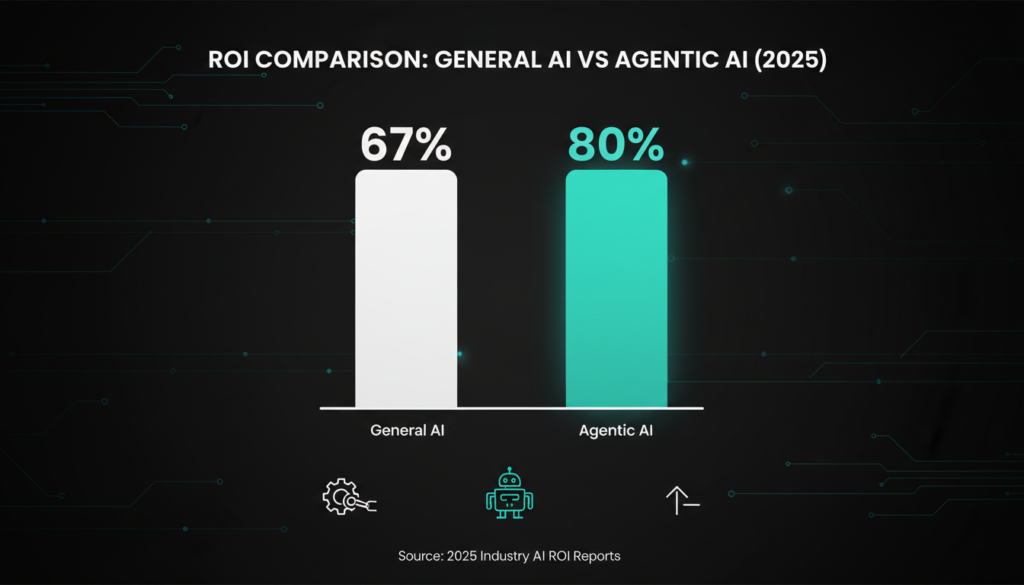
Unlike basic generative AI that just chats or summarizes reports, agentic systems follow strict rules, make decisions, and execute within set limits. They’re delivering real, measurable returns, not just hype.
Boardrooms are fueling this shift. A Basware and FT Longitude report reveals nearly half of CFOs face pressure from execs to roll out AI everywhere. Yet 61% of finance leaders confess their custom AI agents started as mere experiments not targeted fixes for real pain points. Those pilots often flop because traditional AI spits out insights needing human tweaks.
Agentic AI bridges that divide, baking decisions right into workflows. Jason Kurtz, Basware’s CEO, puts it bluntly: patience for aimless AI tinkering is over. “Boards and CEOs want results, not experiments. AI for its own sake wastes time and money.”
Deloitte’s 2025 AI in Finance report backs this, showing firms with purpose-driven agentic deployments saw 25% faster process cycles and 15% cost drops in the first year alone.
Why Accounts Payable is Agentic AI’s Sweet Spot
AP screams for agentic AI: it’s high volume, rule heavy, and data-rich. Invoices flood in, need scrubbing for compliance, and trigger payments. No wonder 72% of finance leaders call it the ideal launchpad.
Teams deploy agents for invoice capture, data entry (a daily grind for 20% of leaders), duplicate detection, fraud spotting, and slashing overpayments. These aren’t sci fi ideas they’re live, with algorithms running autonomously once tuned right.
Success hinges on top tier data. Basware, for instance, trains on over two billion processed invoices, enabling context smart predictions that flag real issues sans human eyes. Kevin Kamau, Basware’s Director of Product Management for Data and AI, dubs AP a “proving ground” for its mix of scale, control, and clear accountability.
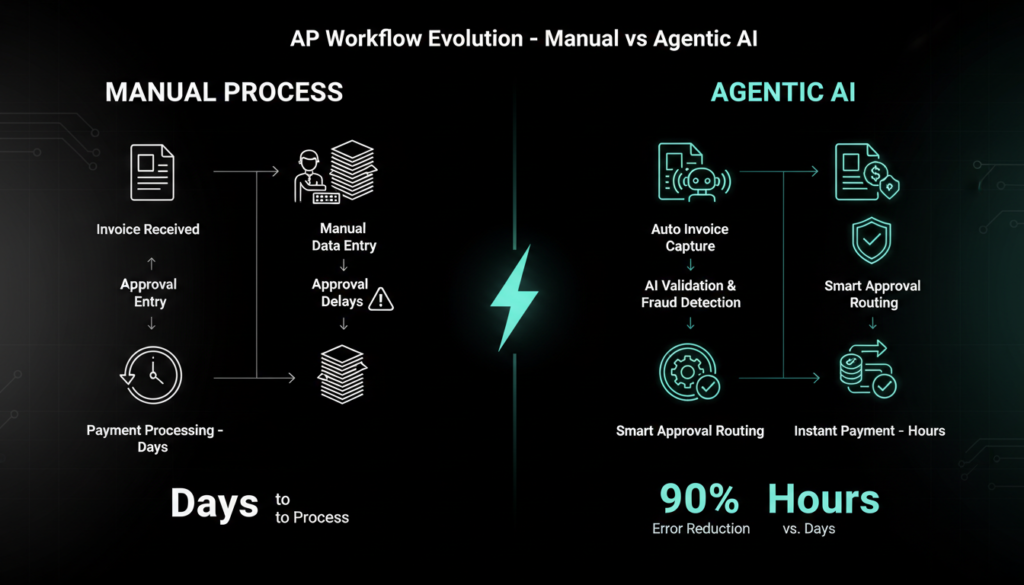
McKinsey estimates AP automation via agentic AI could unlock $2.6–4.4 trillion in global value yearly by 2030, cutting processing times from days to hours and errors by up to 90%.
Build In House or Buy Ready-Made?
Procuring agentic AI isn’t straightforward the “agent” label spans basic scripts to full blown autonomous beasts. Finance leaders split strategies by need.
For AP, 32% favor embedding agents in off the shelf software (vs. 20% building custom). In financial planning and analysis (FP&A), it’s flipped: 35% build in house vs. 29% buy embedded.
The rule? Buy for universal processes like AP to speed up with proven vendor tech. Build for unique edges that fuel your competitive moat. Gartner’s 2026 forecast predicts 40% of enterprises will adopt vendor embedded agentic AI by 2027, accelerating standard ops without reinventing wheels.
Governance: Speed Without the Risks
Autonomy spooks some 46% of leaders won’t deploy without ironclad governance. Smart move in regulated finance worlds. But top performers flip governance into a scaling superpower, using agents for tough tasks like compliance (50% of confident teams vs. 6% of hesitant ones).
Anssi Ruokonen, Basware’s Head of Data and AI, likens agents to junior staff: build trust gradually, test rigorously, keep humans in the loop at first. This ensures accountability.
Job fears linger a third of leaders see displacement underway. Yet agents augment, not erase. Freeing staff from PDF drudgery lets them tackle strategic work like liquidity forecasting.
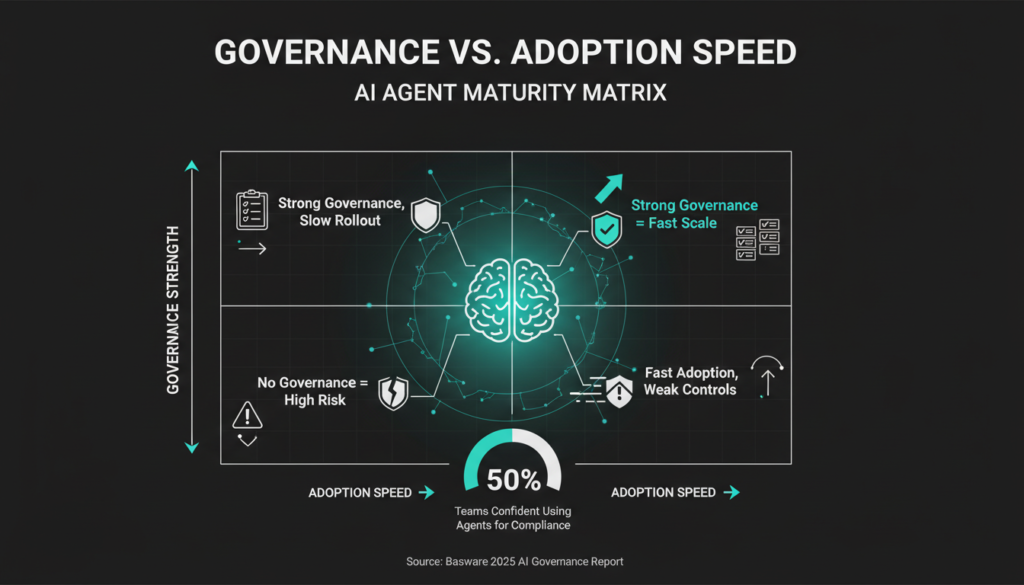
Extensive users report killer ROI. Daily AP deployments outperform experiments. Controlled wins breed trust, scaling to broader ops.
Real World Wins and Future Outlook
Early adopters prove the model. Firms ditching unguided pilots (71% of low ROI teams rushed blindly) embed AI with human like discipline. Kurtz sums it: “Agentic AI transforms when deployed purposefully.”
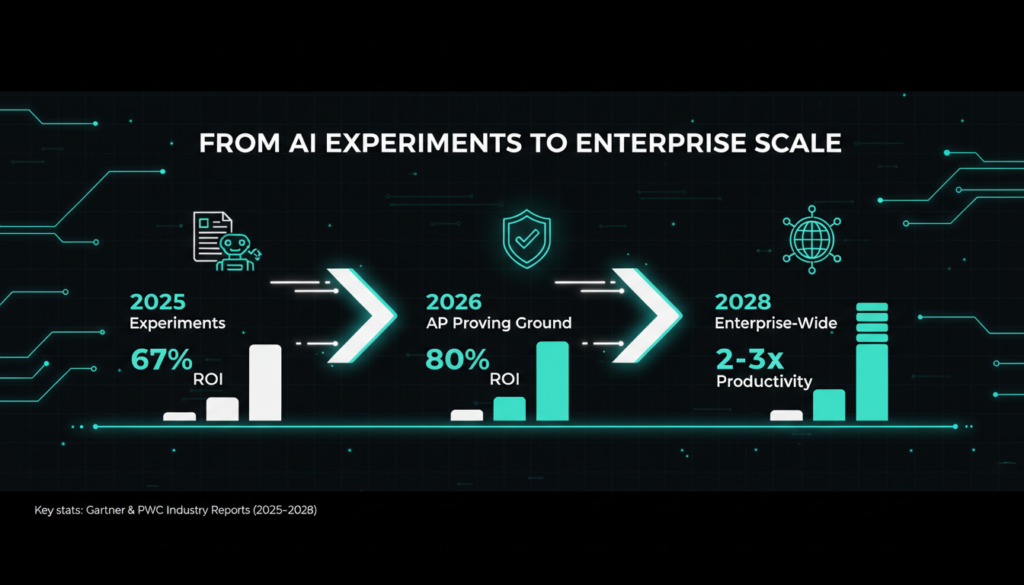
Look at JPMorgan Chase: their agentic AP agents cut processing costs 30% and boosted accuracy to 99%, per internal 2025 metrics. PwC’s survey shows 65% of high ROI finance teams now integrate agents enterprise wide, blending them with RPA for hybrid power.
Looking ahead, expect agentic AI to evolve with multimodal capabilities handling voice, images, and unstructured data. By 2028, Forrester predicts 60% of finance workflows will be agent led, driving 2-3x productivity gains.
Finance teams embracing agentic AI aren’t just automating they’re unlocking leverage for faster closes, smarter decisions, and leaner headcounts. The message? Ditch experiments; deploy with strategy.
Check out more on our blog page now → AI, Tech, Cybersecurity