
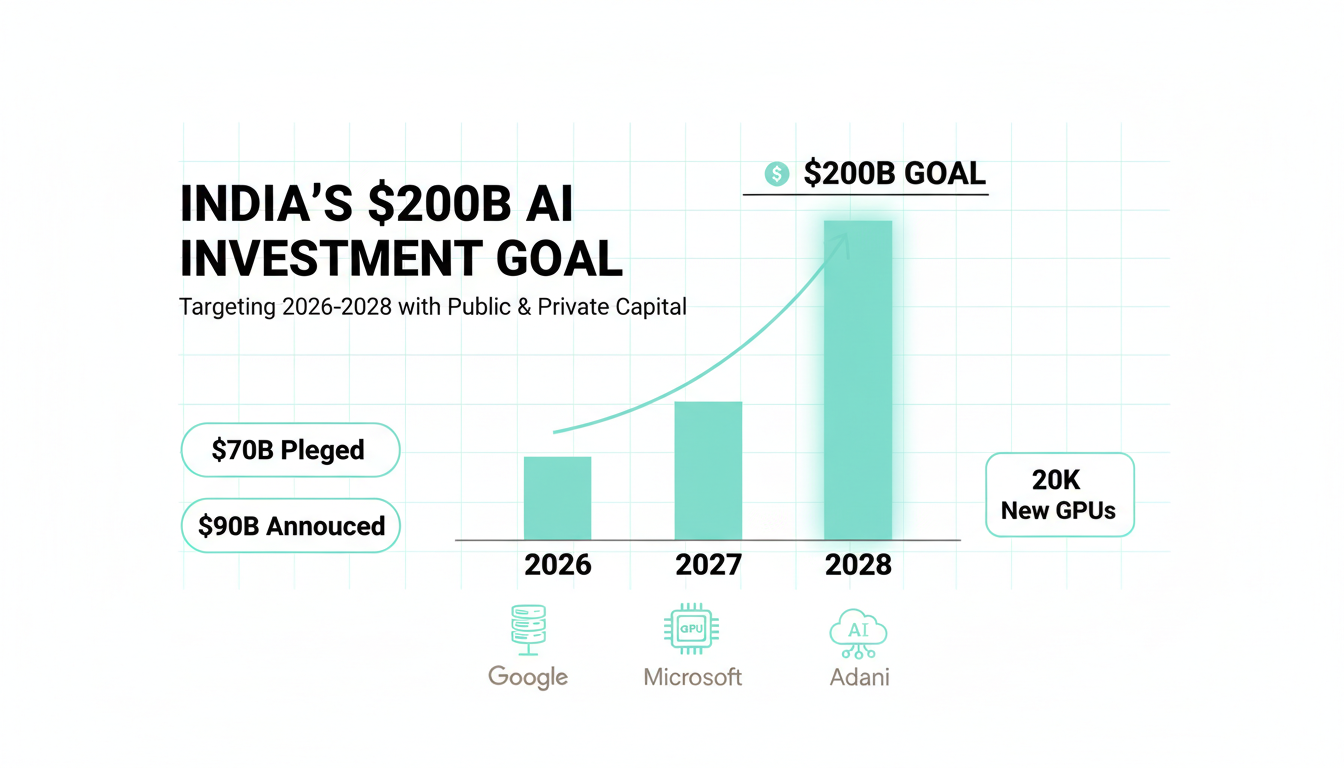
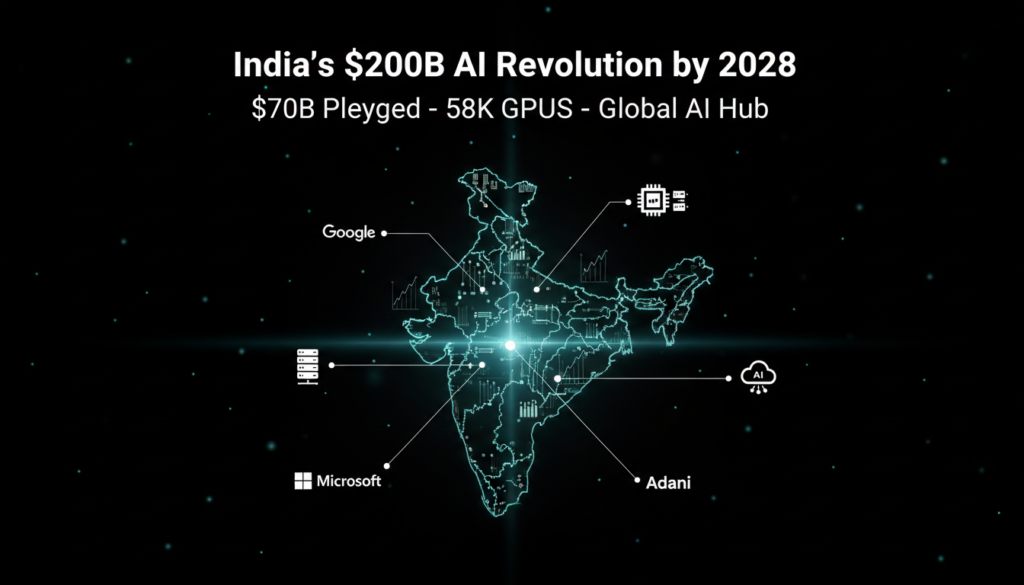
India is aggressively pursuing over $200 billion in AI infrastructure investments by 2028 to become a global AI powerhouse. This bold move, announced by IT Minister Ashwini Vaishnaw at the AI Impact Summit in New Delhi, combines incentives, compute expansion, and policy reforms to draw in global players. Recent updates show commitments have surged, with $70 billion already pledged and another $90 billion announced, pushing totals toward or beyond the $200 billion mark. This momentum reflects India’s strategic positioning amid global AI capacity shortages.
AI Impact Summit Highlights
The five day AI Impact Summit drew top executives from OpenAI, Google, Anthropic, and more, focusing on innovation, safe AI, and democratizing resources. Vaishnaw outlined plans to lure the global AI value chain with tax breaks and venture funding. The summit features seven ‘chakras’ or working groups tackling resilience, human capital, trusted AI, science, resource democratization, social inclusion, and economic development through AI. Discussions emphasized public private collaborations to upskill India’s workforce and update academic curricula for AI readiness. This event aligns with PM Modi’s vision of ‘tech for public good,’ positioning India as a leader in ethical AI deployment across sectors like healthcare, agriculture, and governance.
Major Tech Pledges Fuel Growth
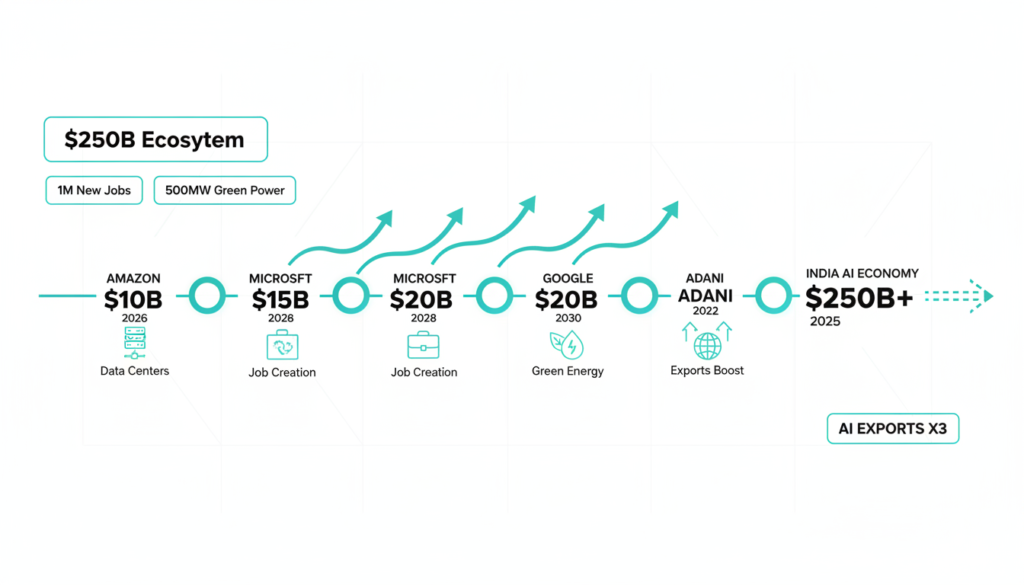
U.S. giants have committed around $70 billion, with Amazon planning $35 billion by 2030 for AI, cloud, logistics, and job creation; Microsoft $17.5 billion by 2029 for AI ecosystem and sovereign cloud; and Google $15 billion in data centers and AI hubs. Indian powerhouse Adani Group announced a massive $100 billion commitment for renewable-energy-powered, AI-ready data centers by 2035, scaling capacity to 5GW and catalyzing another $150 billion in ecosystem investments like server manufacturing and sovereign cloud potentially creating a $250 billion AI infra landscape.
| Company | Investment Amount | Timeline | Focus Areas |
|---|---|---|---|
| Amazon | $35B | By 2030 | AI, cloud, logistics, jobs |
| Microsoft | $17.5B | By 2029 | AI ecosystem, sovereign cloud |
| $15B | Next 5 years | AI hubs, data centers | |
| Adani Group | $100B | By 2035 | AI data centers, renewables |
These pledges shift India from an outsourcing hub to a core AI innovator, projected to create millions of jobs, boost exports, and drive IT spending to $176 billion in 2026 fueled by data centers and AI software growth.
IndiaAI Mission Compute Boost
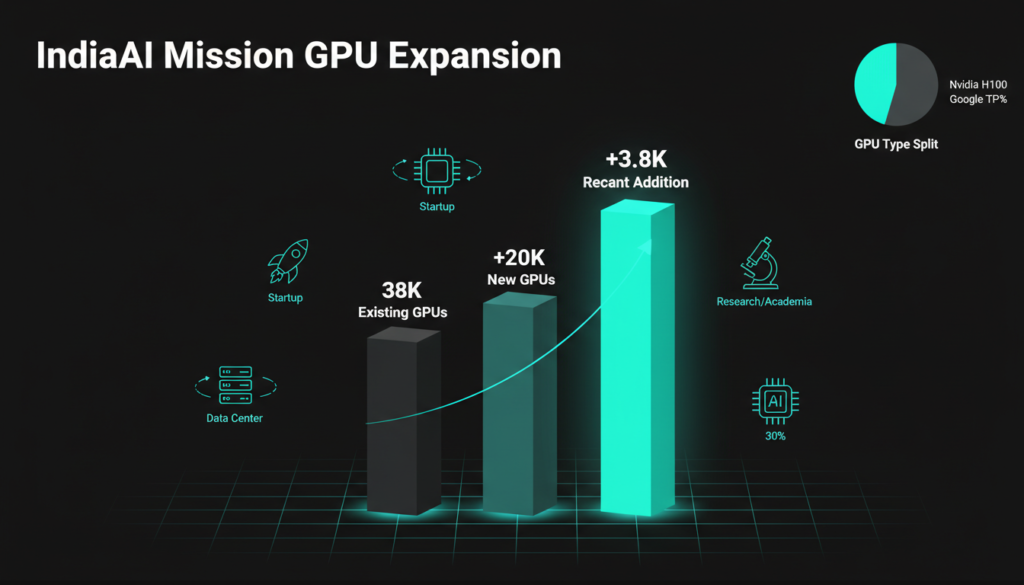
Under the IndiaAI Mission, India is scaling shared compute from 38,000 GPUs with 20,000 more soon, following recent additions like 3,850 GPUs including Google Trillium TPUs and Nvidia H100s. This supports startups building LLMs at affordable rates without massive upfront costs. The mission has exceeded initial 10,000 GPU targets, democratizing AI access for researchers, public institutions, and SMEs. Phase two prioritizes R&D, innovation, tool diffusion, and broader compute availability beyond elite firms. Shared facilities lower barriers, enabling sector-specific AI solutions via public private partnerships, from precision farming to predictive healthcare.
Key Policy Incentives
India offers zero taxes through 2047 on export oriented cloud services, a ₹100 billion ($1.1B) VC fund for AI and deep tech, and extends startup status for deep tech firms to 20 years with ₹3B revenue threshold. These attract hyperscalers and locals like Infosys and Jio. Vaishnaw highlighted VC commitments for deep-tech startups, large scale AI apps, and frontier models. Budget 2026-27 further cements India as a cloud and AI hub with data center incentives. Workforce reskilling via universities, skill programs, and online platforms builds an AI ready talent pool of millions, addressing job displacement fears while unlocking productivity gains.
Challenges and Energy Edge
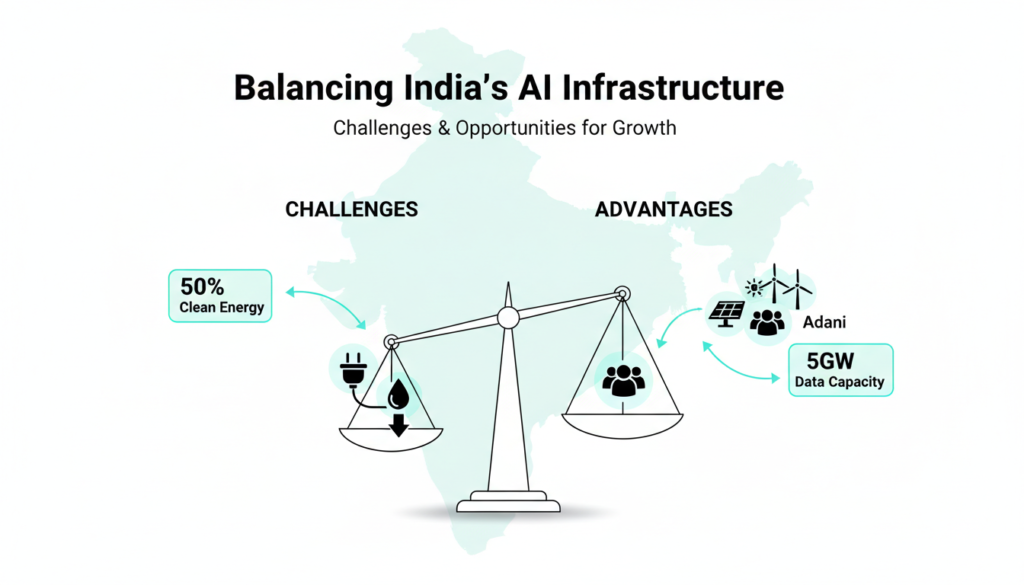
Data centers demand massive power and water, but India’s energy mix over 50% clean sources like solar and wind positions it advantageously as global AI demand surges. Adani’s renewable focus amplifies this strength. Government strategies include sustainable planning, policy stability, and infrastructure upgrades to mitigate risks like power reliability. Vast talent pool and cost advantages further bolster investor confidence. Success hinges on execution, but early wins in GPU rollout and Big Tech buy-in signal progress toward compressing decades of infra buildout into years.
Global Implications
India’s AI push could reshape global computing amid capacity shortages, rising costs, and U.S.-China tensions. By blending scale, low costs, incentives, and green energy, it captures more value chain, including $17B in deep tech apps. Outcomes will influence worldwide strategies, offering firms diversified AI footprints. India’s model shared compute, talent, policy could inspire emerging markets, accelerating equitable AI diffusion globally. With IT spending hitting $176B in 2026 and AI infra booming, India eyes leadership in the intelligence revolution, driving economic transformation at population scale.
Check out more on our blog page now → AI, Tech, Cybersecurity