
At the snow covered World Economic Forum in Davos, Switzerland, the mood around AI is calm, confident, and a little defensive. While some outside the conference are ringing alarm bells about an AI bubble, the big tech leaders and investors gathered there are painting a different picture: this isn’t a speculative frenzy; it’s the biggest infrastructure buildout in human history.

The cold truth behind the AI hype
In January 2026, the gap between the AI “haves” and “have nots” feels sharper than ever, even within the tech world. One of the most visible “have not” moments came from Sam Altman, CEO of OpenAI.
Once known for bold predictions about artificial general intelligence (AGI) arriving imminently, Altman recently backed down and admitted that parts of the AI sector are, in fact, in a bubble. With ChatGPT’s operating costs soaring and subscription revenue alone not covering the bill, OpenAI has had to make some awkward moves.
Last week, Altman announced that OpenAI is finally bringing ads to ChatGPT, something he had previously called “a last resort” for the company. The irony didn’t go unnoticed. A popular LinkedIn post this week showed an AI generated image of Altman shivering in the cold, holding a cardboard sign that reads: “AGI=Ads Generate Income,” a self mocking jab at how much the AI dream now depends on advertising.
Davos: the AI bubble denial zone
Contrast that with the warm, well heated rooms of Davos, where the annual World Economic Forum convenes billionaires, CEOs, and central bankers. Here, the narrative around AI is far more optimistic and dismissive of the bubble talk.
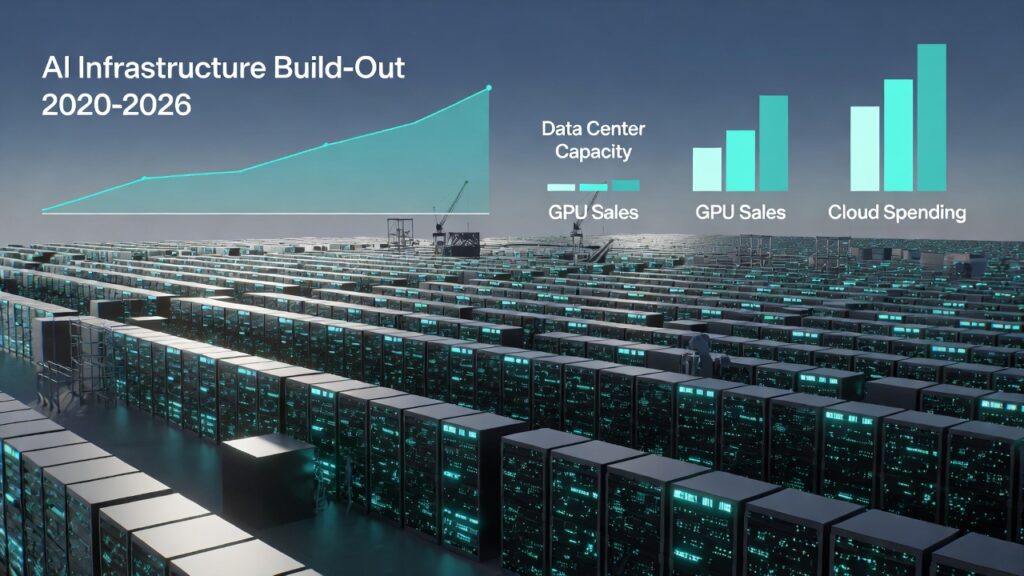
Jensen Huang, CEO of Nvidia the company whose powerful GPU chips have turbocharged the AI boom and pushed its market valuation past $4 trillion put it bluntly when asked about the AI bubble. “This is the largest infrastructure build out in human history,” Huang said, referring to the massive wave of data center projects being planned and built around the world.
Huang didn’t exactly deny the bubble label; instead, he reframed it as a sign of necessary investment. According to him, the “AI bubble” exists because the investments are huge, and the investments are huge because the world needs to build the underlying infrastructure that all future AI layers will run on.
A “rational bubble” vs. a crash waiting to happen
Not everyone at Davos is entirely blind to risk, but even the warnings are comforting. Larry Fink, CEO of BlackRock (which holds over $200 billion in Nvidia stock), acknowledged that there will be big failures in AI, but insisted: “I don’t think we are in a bubble”.
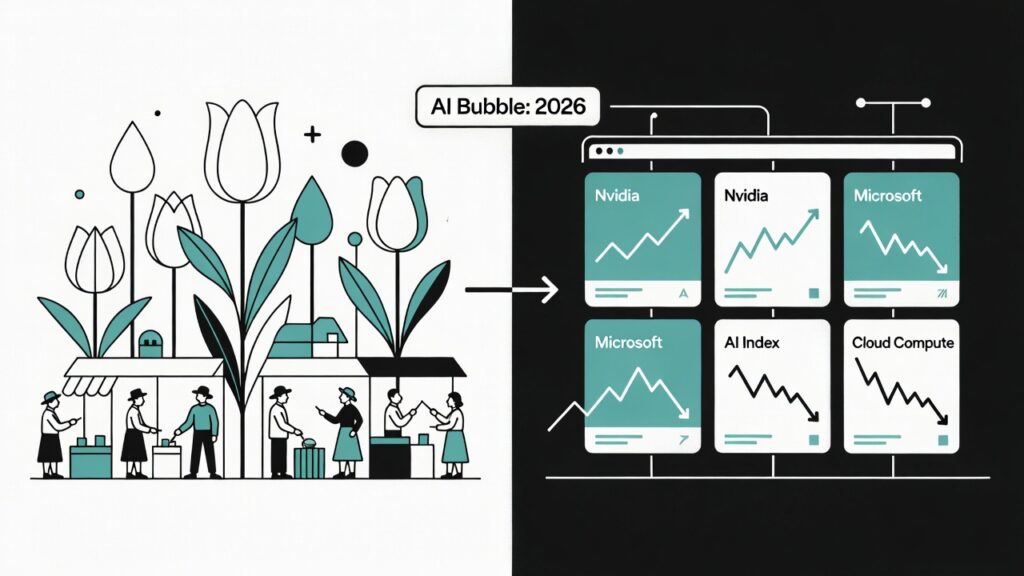
An economist at Davos, Nobel Prize winning Peter Howitt from Brown University, described the current AI stock surge as a “rational bubble” not unlike the infamous tulip bulb mania of the 17th century, but with a crucial difference. “There’s something real out there,” Howitt argued, implying that AI’s underlying technology is worth the hype in a way tulips never were.
He predicted that the bubble will eventually burst when it becomes clear who the real winners are. “At some point, when it becomes a little clearer who the winners are going to be, the values of the other firms are going to start to fall, and that’s when the crash will take place,” Howitt said.
The infrastructure tail wagging the dog
In this Davos view, the tail really is wagging the dog. Nvidia’s record chip sales are driving so much data center construction that the sector’s valuation looks more like a bet on infrastructure than on short term AI profits.
What’s left unsaid, however, is what happens if the AI projects running on that infrastructure don’t actually deliver strong returns for ordinary businesses. If AI models can increasingly be trained with relatively modest compute (like DeepSeek’s recent breakthrough, which used far less data center power than traditional giants), the entire rationale for endless infrastructure spending could weaken.
This is the paradox: Nvidia’s success story depends on massive AI compute demand, but the next wave of AI might actually reduce that demand, not increase it.
Microsoft’s warning: “If AI only helps tech firms, it’s a bubble”
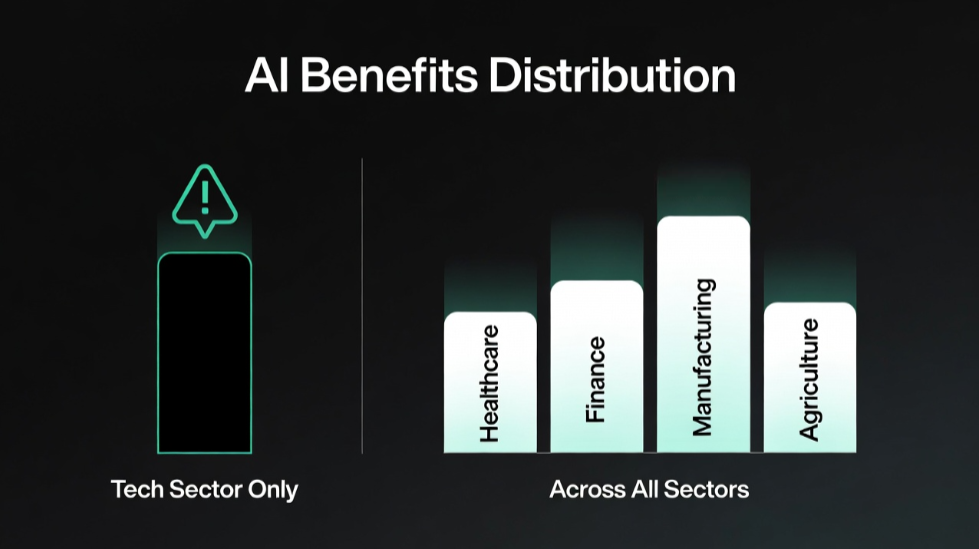
Microsoft’s CEO Satya Nadella, while outwardly optimistic about AI, delivered one of the most sobering notes of the Davos AI conversation. He agreed that if AI remains confined to a handful of tech giants, it absolutely will become a classic bubble.
“The real question in front of all of us is how do you ensure that the diffusion of AI happens, and happens fast,” Nadella said at the forum. “For this not to be a bubble by definition, it requires that the benefits of this are much more evenly spread”.
Nadella’s point is simple: if AI only boosts profits at Microsoft, Nvidia, and a few other cloud/AI players, while most companies and workers see little gain, then the current high valuations are fundamentally unjustified and will eventually collapse. He’s been criticized by some investors for heavy spending on AI infrastructure, but this is exactly why he sees broad adoption as a survival requirement, not just a nice to have.
Who are the real winners?
So who actually stands to win this AI “race”? Obviously, Nvidia is in a powerful position, selling the chips that power nearly every major AI model. Microsoft, too, has a strong hand: it holds a 27% stake in OpenAI and enjoys deep integration between Azure cloud and OpenAI’s models.
If Altman’s OpenAI continues to struggle to pay for its own AI overreach, Microsoft could step in to buy OpenAI outright, effectively turning the ChatGPT maker into a full subsidiary, much like how it acquired LinkedIn or GitHub.
Beyond the current big players, the real winners may be the companies (and countries) that can commercialize AI profitably in non‑tech sectors: healthcare, logistics, energy, manufacturing, and education. Those are the entities that will turn the AI infrastructure boom into real productivity and economic gains, rather than just inflated valuations.
What Davos isn’t saying
The Davos narrative is essentially threefold: first, this is infrastructure, not a bubble. Second, even if it is a bubble, it’s a “rational” one with real underlying technology. Third, it only becomes dangerous if the benefits don’t spread beyond the tech sector.
What’s missing is serious discussion of downside scenarios: what if returns on AI remain stubbornly low for most businesses? What if regulation, ethical issues, or public backlash slow adoption? And what if the next wave of AI is cheaper and more efficient, undermining the very infrastructure that’s being built at such scale?
Bottom line: are we in an AI bubble?
At Davos, the official answer is a polite “no.” To the tech giants and their investors, the massive spending on AI compute looks like building the railroads and power grids of the 21st century essential, long‑term bets, not short term speculation.
But outside the snow covered luxury hotels, the story is messier. Sam Altman’s pivot to ads on ChatGPT, the fear of slow ROI in enterprise AI, and the potential for a “rational bubble” to turn irrational all suggest that the bubble risk is very real.
The real test won’t be in Davos, but in the everyday economy: when AI boosts productivity and profits across factories, hospitals, banks, and schools, not just in tech balance sheets. Until then, the debate over the AI bubble is far from over.
Explore More Insights
Ready to dive deeper into the future of technology? Check out our other engaging blog posts on AI, Tech, and Cybersecurity right here on our page. From cutting-edge innovations to essential security tips, there’s something for every tech enthusiast!