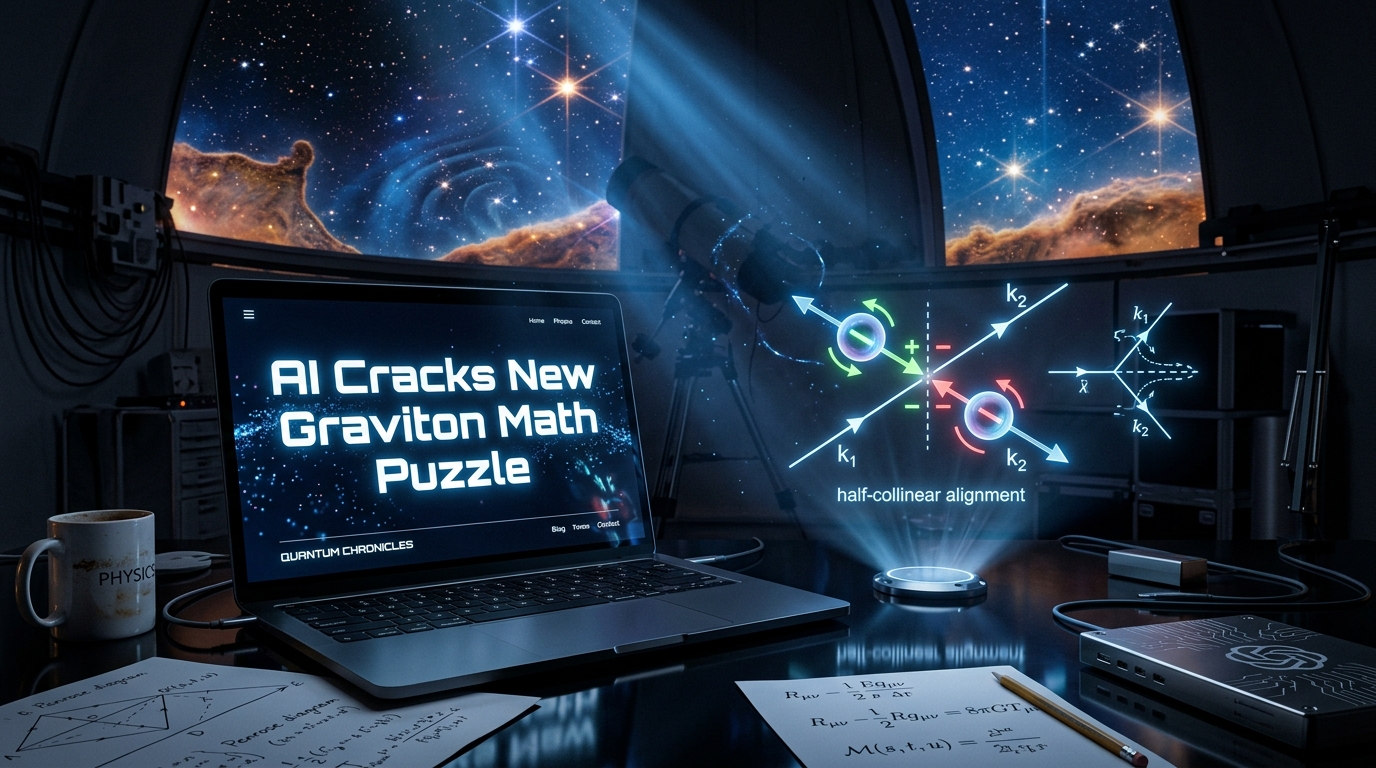
Researchers at OpenAI turned to GPT-5.2 Pro to uncover a fresh mathematical breakthrough in quantum gravity. This work extends recent gluon findings to gravitons, revealing how these elusive particles might interact in ways long thought impossible. It’s a prime example of AI accelerating pure physics research.
What Are Single Minus Amplitudes?
Scattering amplitudes are the secret sauce of particle physics. They let scientists skip the messy details of particle collisions like drawing hundreds of Feynman diagrams and jump straight to the odds of specific outcomes. Think of it as a cheat code for predicting how particles smash and scatter.
In quantum gravity, the stars are gravitons: hypothetical particles that carry gravity at the quantum scale. The new preprint dives into “single-minus” amplitudes, where one graviton has negative helicity (its spin angled against its motion) and all others have positive helicity. Textbooks claim these should be zero at tree level the basic, loop-free approximation of interactions. But that’s only if particles move in generic ways.
The twist? In the “half-collinear regime,” where particle momenta align just right, these amplitudes don’t vanish. They become well defined distributions in a narrow slice of momentum space. Authors derived exact formulas using symmetry principles and recursion relations building big interactions from tiny ones, like stacking Lego blocks. This echoes broader trends in amplitudeology, where hidden simplicities emerge, as seen in work by Nima Arkani Hamed and Jaroslav Trnka on amplituhedrons (geometric objects encoding scattering without locality or unitarity assumptions).
Expanding on this, single minus amplitudes tie into the “w-(1+∞)” symmetry, an infinite dimensional beast spotted by Roger Penrose in classical gravity 50 years ago. Penrose’s twistor theory reframes spacetime as complex geometry, and this symmetry governs how gravitational waves behave near black holes or in asymptotic flat space. The preprint demonstrates it acts on gravitons quantum mechanically, a step toward quantizing gravity. Recent extensions, like those in 2024 arXiv papers on celestial holography, suggest these symmetries underpin soft graviton theorems, linking quantum gravity to boundary dynamics (see Cachazo and Strominger’s celestial amplitudes framework).
This isn’t just math trivia it’s progress on quantum gravity’s holy grail: merging quantum mechanics with Einstein’s general relativity. Gravitons challenge us because gravity is nonlinear; unlike photons or gluons, they self interact fiercely.
How GPT-5.2 Pro Made It Happen
Gravity calculations are beasts compared to gauge theories like QCD for gluons. The gluon breakthrough showed neglected helicity configs could yield non-zero results under special kinematics. OpenAI fed that paper to GPT-5.2 Pro, asking it to adapt for gravity a task that would’ve bogged humans down for months.
The AI nailed it with the “directed matrix-tree theorem,” a clever tool from graph theory repurposed for amplitudes. It generated formulas blending recursion (Britto Cachazo Feng Witten relations) and symmetries, then drafted a solid paper skeleton. Humans verified everything analytically, cross-checked limits, and confirmed Penrose symmetry consistency.
This mirrors AI’s rising role in physics. Similar feats include DeepMind’s 2024 work on knot theory invariants and Anthropic’s Claude aiding in string theory compactifications. Verification ate most time conjectures flew fast, but proofs demand rigor. It’s flipping the script: AI for ideation, humans for polish.
Gluon to graviton transfer highlights shared structures. Both use twistor variables and on shell methods, per Edward Witten’s 2004 twistor string insights. Gluons probe strong force; gravitons, spacetime curvature. This cross-pollination fuels “bootstrap” programs, recursively deriving theories from consistency alone.
Why This Matters for Quantum Gravity
These amplitudes spotlight non vanishing graviton interactions, challenging MHV (maximally helicity-violating) dogma. In tree level gravity, they’re distributions, not delta functions spread over kinematics like probability clouds. Explicit formulas match soft limits, where low-energy gravitons dress hard scatters (Weinberg’s theorem).
Broader context: Quantum gravity evades direct tests, but amplitudes probe string theory duals and AdS/CFT holography. Penrose’s symmetry links to BMS supertranslations at null infinity, per Strominger’s 2010s infrared triangle. 2025 updates from IAS seminars extend this to loop-level, hinting at UV finiteness.
AI’s speed up is game changing. Traditional amplitude hunts took decades (Parke-Taylor for gluons in 1984); now, GPT iterates hypotheses instantly. Yet, pitfalls loom hallucinations demand checks, as in a 2025 NeurIPS paper critiquing AI physics proofs.
Future Horizons in AI Physics Fusion
Next up: Multi-minus extensions, loop corrections, and phenomenology ties (e.g., gravitational wave interferometers like LIGO detecting quantum imprints). This builds an AI-human loop for theoretical physics, upholding rigor amid rapid conjectures.
As AI tools evolve, expect more bridges between machine learning and fundamental forces. This graviton leap proves AI isn’t replacing physicists it’s supercharging discovery.
Check out more on our blog page now → AI, Tech, Cybersecurity