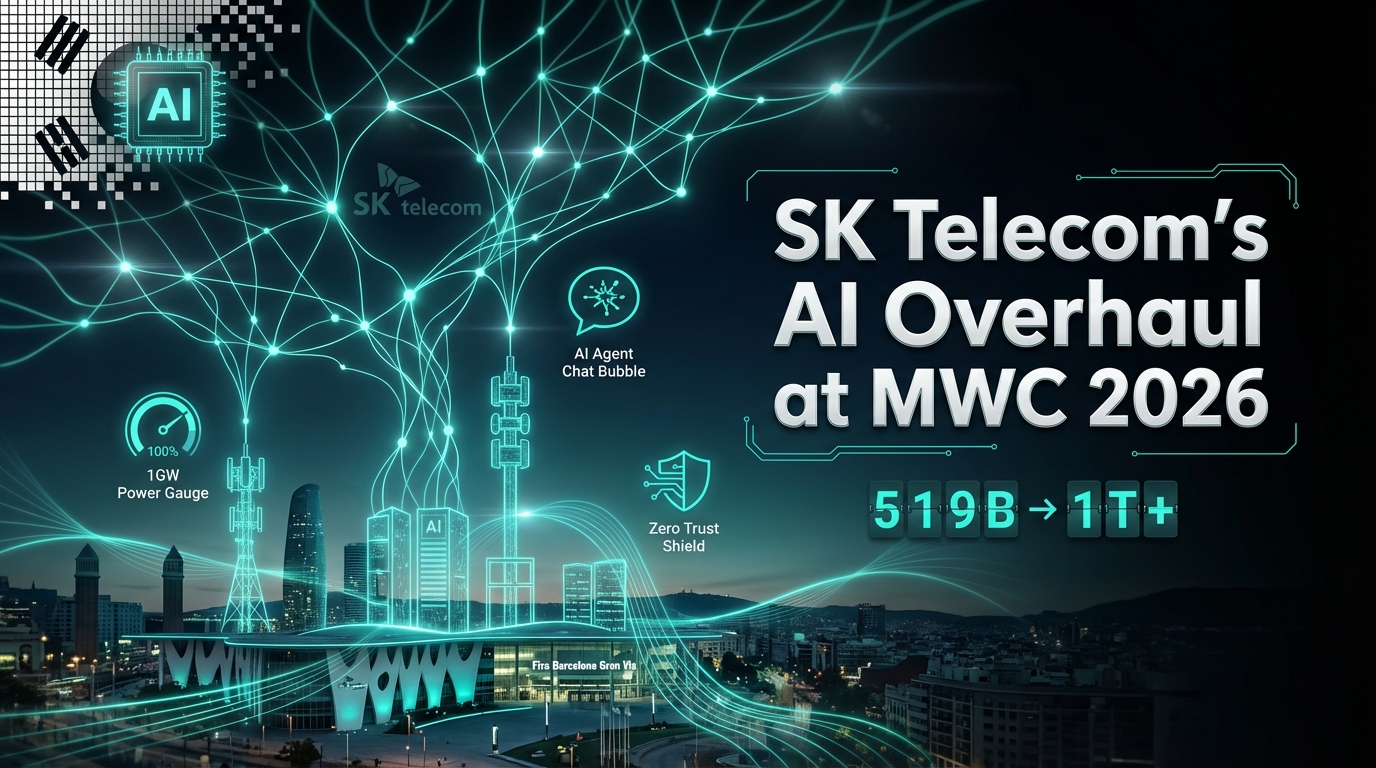
At MWC 2026 in Barcelona, SK Telecom didn’t just talk AI they revealed a bold blueprint to remake their entire operation around it. This “AI Native” strategy transforms everything from network cores to customer chats, backed by massive data center builds and trillion parameter models. It’s a telecom giant betting big on AI to lead Korea’s charge into the global top three AI nations.
CEO Jung Jai-hun called it a “golden time of transformation,” where customer value meets AI innovation in a borderless world. “We put customers at the heart of our business,” he said, “and AI will drive real contributions for them and Korea.” This isn’t hype; it’s a full rewrite of legacy systems, with investments aiming to redefine telecom for the AI era.
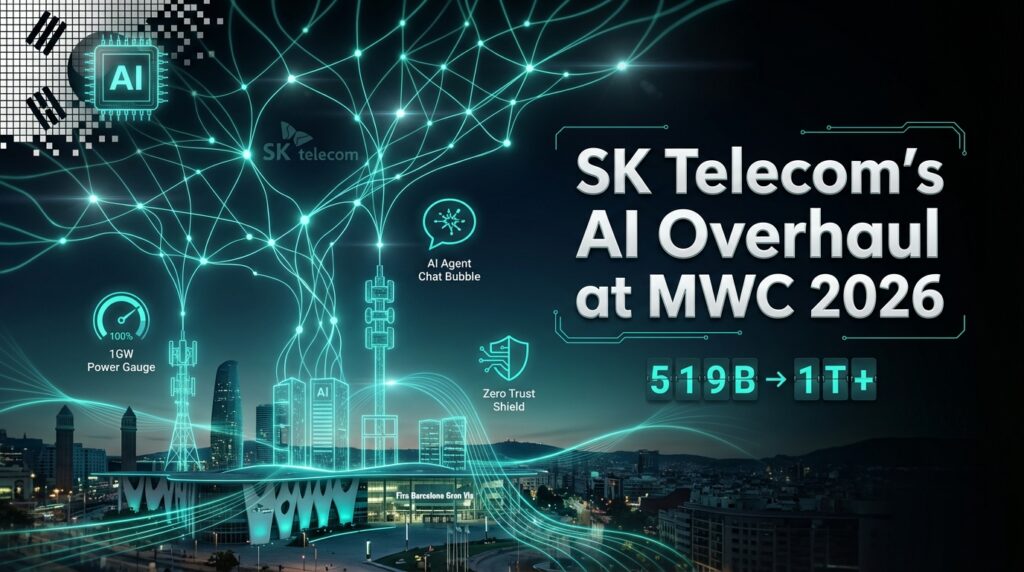
Rebuilding Core Systems with AI
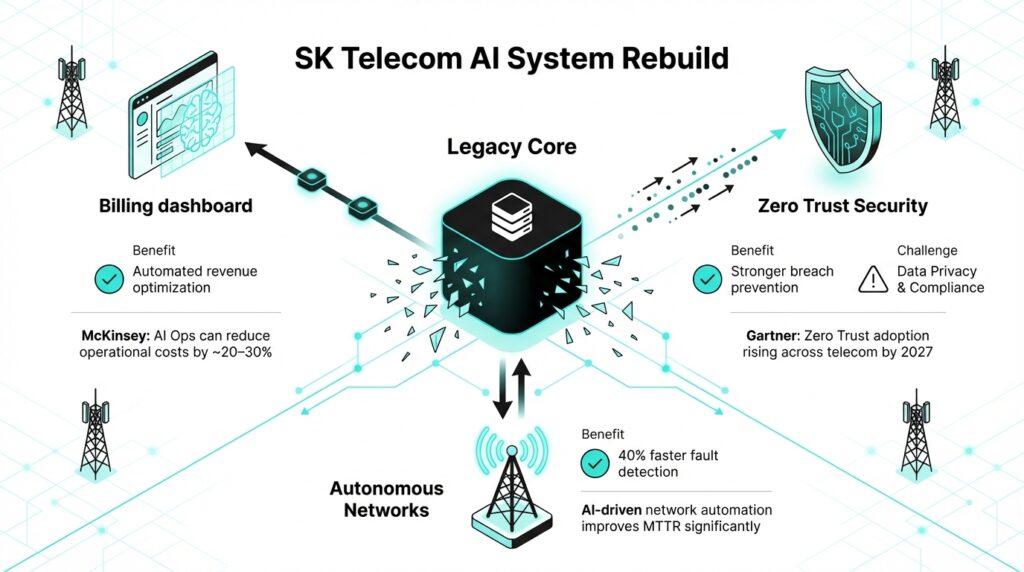
SK Telecom is gutting its integrated IT backbone sales, line management, and billing to make them AI optimized. The goal? Personalized plans tailored to your usage habits, like auto adjusting data packs for heavy streamers or gamers. This shift promises dynamic pricing and memberships that evolve with behavior.
They’re layering on Zero Trust security too: think ironclad authentication, micro segmented networks, and AI that spots threats in real time. According to their MWC briefing, this combats rising cyber risks in telecom, where breaches cost operators $4.5 million on average per incident (per IBM’s 2025 Cost of a Data Breach report).
For the industry, this is seismic. Legacy billing stacks from the 90s can’t handle AI’s data deluge. Gartner’s 2026 telecom forecast notes that AI-rebuilt cores could cut fault detection time by 40%, revolutionizing service design. But it sparks debates on data ethics how will anonymized customer patterns train models without privacy slips? SK Telecom insists on governance-first, aligning with EU AI Act standards.
They’re also pushing “autonomous networks.” AI will handle wireless quality, traffic routing, and gear ops via AI-RAN tech, slashing latency for 6G previews. McKinsey reports similar pilots at Verizon reduced downtime by 30%; SK Telecom aims higher, targeting gigabit speeds nationwide.
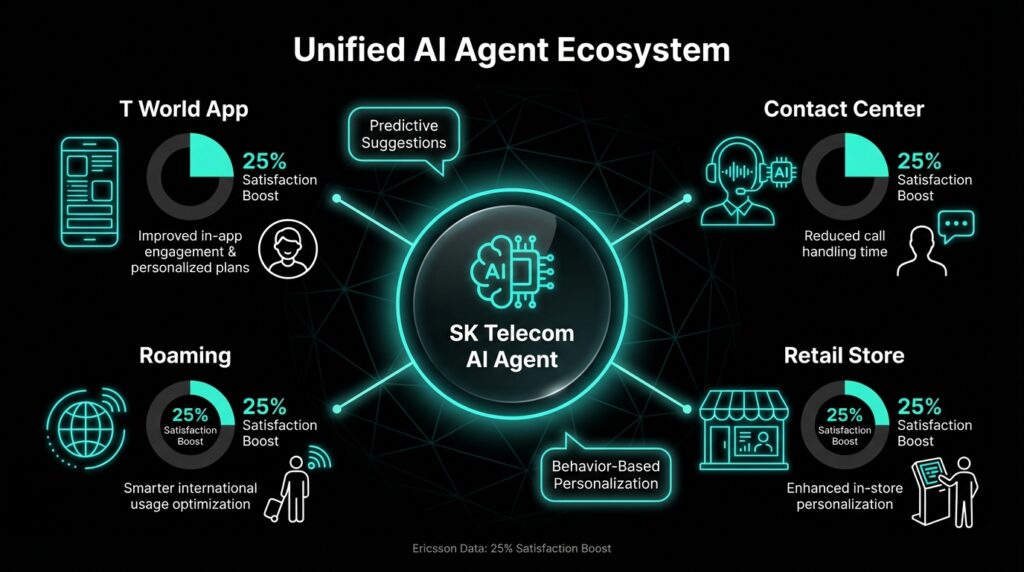
One AI Agent for Seamless Customer Experiences
Customer touchpoints get a unified AI agent spanning the T World portal, T Direct Shop, and beyond. It analyzes daily patterns to suggest roaming deals or upgrades like nudging you toward unlimited international data before your trip.
The AI Contact Center empowers reps with real time insights during calls, while offline stores use it for post-visit recommendations. “AI Personas” profile segments for smarter Q&A, shifting from reactive fixes to predictive perks.
This echoes a global trend: Telecoms like Vodafone and AT&T are piloting similar agents. A 2025 Ericsson study found AI agents boost satisfaction by 25%, but scale is key. SK Telecom’s version embeds across channels, treating AI as the core OS, not a bolt on chatbot.
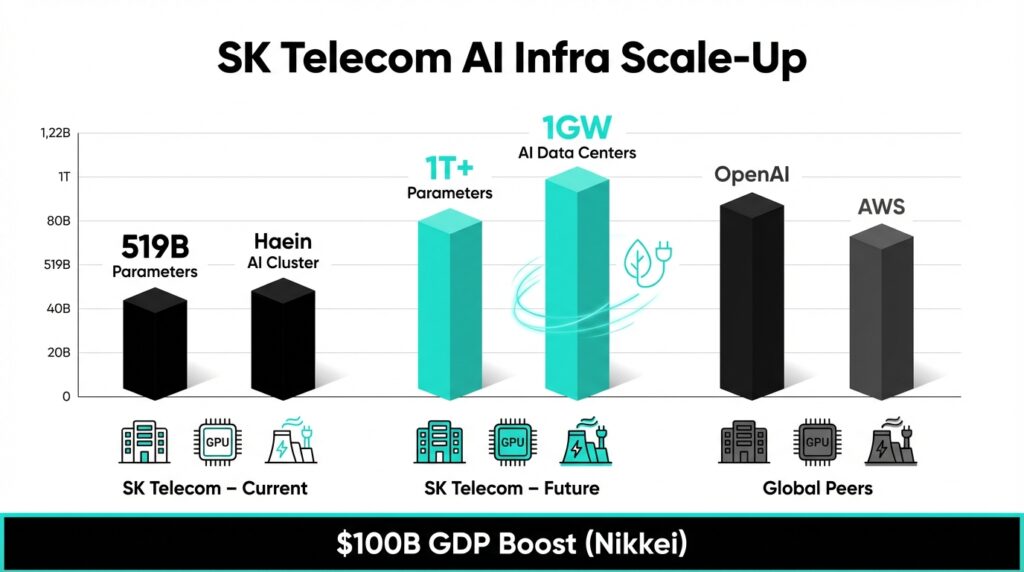
Massive 1GW AI Data Centers on Horizon
Infrastructure is the powerhouse here. SK Telecom plans hyperscale data centers hitting 1GW+ across Korea, luring global cash to make it Asia’s AI hub. Their Haein GPU cluster and Petasus AI Cloud already offer GPU as a service; now, it’s going worldwide.
A standout: Partnering with OpenAI for a southwestern Korea data center. Their homegrown model boasts 519 billion parameters Korea’s biggest and jumps to over 1 trillion by year end, adding multimodal smarts for images, voice, and video.
Jung likened data centers to Korea’s “heart” and LLMs to its “brain.” This national push mirrors Singapore’s AI hubs, per a 2026 Nikkei Asia analysis, which could add $100B to regional GDP. For enterprises, applications shine: Teaming with SK hynix on manufacturing AI that crunches real time process data to cut defects by 20% and amp efficiency sold as ready to deploy infra model solution stacks
Challenges loom, though. Power demands for 1GW centers rival small cities (think 1 million homes), pushing green energy needs. SK Telecom eyes renewables, aligning with global net zero telecom pledges.
Transforming Company Culture Internally
AI isn’t just external it’s reshaping SK Telecom’s DNA. The AX Dashboard tracks AI adoption per team and employee. An AI Board steers the ship, and the no code “AI Playground” has spawned 2,000+ agents in marketing, legal, and PR.
Jung stressed reinventing work: “Fundamentally transform our culture to be AI centered.” This holistic tie in of infra, models, apps, and governance sets it apart. Deloitte’s 2026 AI adoption survey shows companies like this see 2.5x faster innovation; SK Telecom’s execution will test that.
Globally, it’s a model for enterprises. Telecoms lag in AI maturity (Forrester ranks them behind finance), but SK Telecom’s playbook blending sovereign models with partnerships could accelerate catch up. Watch for ripple effects in predictive maintenance and hyper personalization.
SK Telecom’s MWC 2026 vision positions AI as the new telecom normal. From core rebuilds to cultural overhauls, it’s a high stakes play that could redefine the sector. Success here might inspire US giants like Verizon to double down, fueling an AI arms race in connectivity.
Check out more on our blog page now → AI, Tech, Cybersecurity