
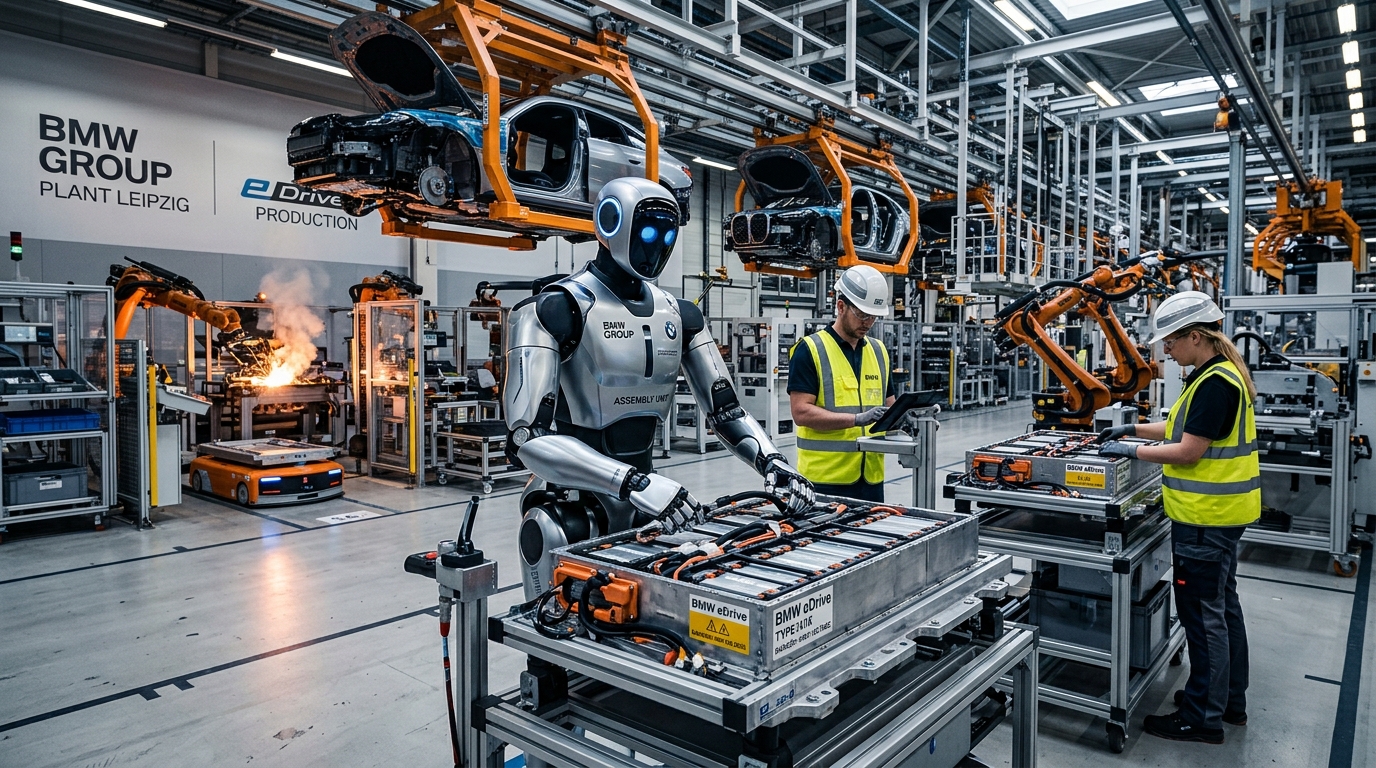
BMW is making headlines across Europe as the luxury automaker deploys humanoid robots in its production facilities in Germany. This bold move signals a significant shift in automotive manufacturing and has industry watchers across the continent closely monitoring the results. The integration of humanoid robots into BMW’s production line represents not just a technological advancement, but potentially a fundamental change in how European factories operate.
Why BMW Is Leading the Charge
The decision by BMW to implement humanoid robots stems from several converging factors. Labor shortages in manufacturing have become increasingly problematic across Europe, with skilled workers becoming harder to recruit and retain. Additionally, the need for consistent quality, increased production efficiency, and the ability to handle repetitive or ergonomically challenging tasks has pushed BMW to explore robotic solutions that go beyond traditional industrial automation.
Unlike conventional industrial robots that are fixed in place and perform single, repetitive motions, humanoid robots offer greater flexibility and adaptability. They can navigate factory floors, use tools designed for human hands, and potentially work alongside human employees in collaborative environments. This versatility makes them particularly attractive for complex manufacturing environments like those found in BMW’s German facilities.
The Technology Behind BMW’s Humanoid Robots
The humanoid robots deployed by BMW are sophisticated machines equipped with advanced sensors, computer vision systems, and artificial intelligence. These robots can process visual information, make real-time decisions, and adapt to changing conditions on the factory floor. Their design mimics human form and movement, allowing them to perform tasks that would be difficult or impossible for traditional robotic systems.
Each robot is capable of learning through both programmed instructions and observation, meaning they can improve their performance over time. This learning capability is crucial for the complex assembly processes used in BMW’s manufacturing, where precision and adaptability are essential. The robots are also designed with safety features that allow them to work safely alongside human workers, sensing proximity and adjusting their movements accordingly.
Impact on BMW’s Production Process
BMW has strategically implemented humanoid robots in specific areas of its production process where they can deliver the most value. These include tasks that are physically demanding, require extreme precision, or involve exposure to potentially hazardous conditions. By taking on these roles, the robots free up human workers to focus on more complex, creative, or quality-control oriented tasks.
Early reports from BMW’s German facilities suggest that the integration of humanoid robots has led to improvements in production consistency and efficiency. The robots can work continuously without fatigue, maintain precise movements regardless of shift length, and perform repetitive tasks without the quality degradation that can occur with human workers over time. This consistency is particularly valuable in luxury vehicle manufacturing, where quality standards are exceptionally high.
Europe’s Manufacturing Sector Takes Notice
The automotive industry in Europe is closely watching BMW’s experiment with humanoid robots, as the implications could be far-reaching. Germany, in particular, has a strong manufacturing tradition and is home to many other major automakers who may follow BMW’s lead if the results prove successful. The potential for humanoid robots to address labor shortages while maintaining or improving production quality is especially appealing in a region facing demographic challenges and increasing competition from other global manufacturing centers.
Other European manufacturers outside the automotive sector are also monitoring the situation. Industries such as aerospace, electronics, and heavy machinery could potentially benefit from similar robotic implementations. The success or failure of BMW’s initiative could influence investment decisions and technological adoption timelines across multiple sectors of European manufacturing.
Economic and Workforce Implications
The deployment of humanoid robots raises important questions about the future of work in European manufacturing. While BMW emphasizes that these robots are designed to complement rather than replace human workers, the long-term implications for employment are a subject of debate. Some analysts suggest that while certain jobs may be automated, new roles will emerge in robot maintenance, programming, and supervision.
The economic implications extend beyond individual factories. If humanoid robots prove successful in improving productivity and quality, they could help European manufacturers remain competitive against lower-cost production regions. This could be particularly important for maintaining manufacturing jobs in high-wage economies like Germany, where labor costs are significantly higher than in many competing nations.
Challenges and Considerations
The implementation of humanoid robots is not without challenges. The initial investment costs are substantial, and integrating these sophisticated machines into existing production systems requires careful planning and execution. There are also questions about long-term maintenance, software updates, and the need for specialized technicians to service the robots.
Additionally, BMW and other manufacturers must navigate regulatory frameworks, worker safety considerations, and potential union concerns. The cultural acceptance of robots in the workplace, particularly in a country like Germany with strong worker protections, will be an important factor in the success of these initiatives.
Looking Ahead: The Future of Manufacturing
BMW’s deployment of humanoid robots in Germany represents a significant milestone in the evolution of manufacturing technology. As these robots prove their capabilities in real-world production environments, they may pave the way for broader adoption across Europe and beyond. The success of this initiative could accelerate the development of even more advanced robotic systems, potentially leading to factories where human and robot workers collaborate seamlessly.
For now, the manufacturing world watches with interest as BMW’s experiment unfolds. The lessons learned from this deployment will likely influence not just automotive manufacturing but the broader industrial landscape across Europe. Whether humanoid robots become a standard feature of European factories or remain a specialized tool may depend on the results BMW achieves in the coming months and years.
As the automotive industry continues to evolve with electrification, connectivity, and now robotics, BMW’s willingness to embrace cutting-edge technology positions the company as a potential leader in the next generation of manufacturing. The success of their humanoid robot initiative could well determine whether Europe’s manufacturing sector takes a significant step into an automated future or proceeds more cautiously with traditional approaches.
Check out more on our blog page now → AI, Tech, Cybersecurity